Our history since 1947
The adventure of a French fishing company
1947 – 1980
The pioneering days

It all began in 1947 driven by the determination of a few pioneers from Reunion Island ready to face the hostile seas at the ends of the earth. From its inception, SAPMER has been founded by a unwavering passion that still drives all our teams today.
1947
The dream of three businessmen
Three Reunion Islanders, Jean Chatel, Georges Michel and Raymond Latour, create the « Société anonyme de pêche malgache et réunionnaise » : SAPMER.


The Cancalais
SAPMER’s founders aimed to equip the island with a vessel that could meet local fish market demands while exploring the untaped potential of rock lobster.
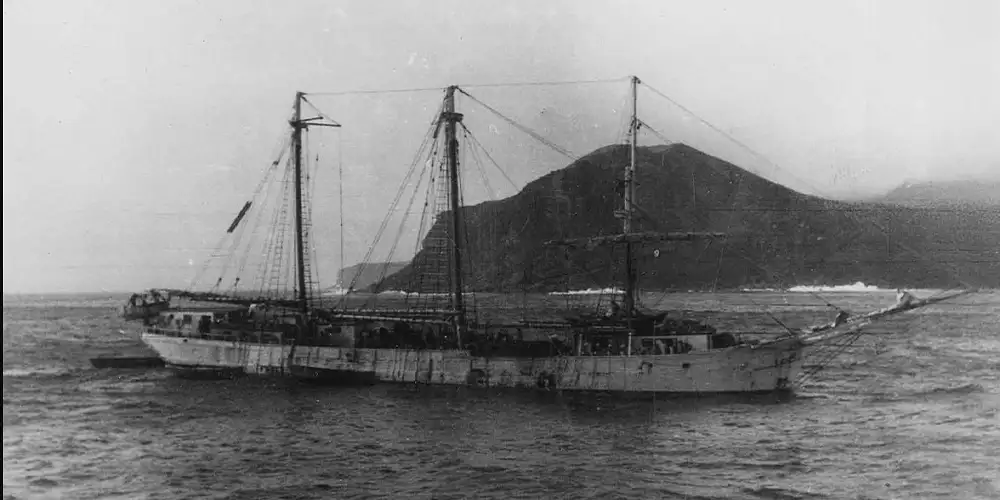
A Madagascan shipowner joined the union, and his contribution to the company was the Cancalais. This three-masted auxiliary-engine vessel, a former terre-neuvas, which used to make coastal calls to Madagascar, became the fleet’s first ship.
1948
The conquest of the southern seas
The Cancalais, with its of 46 sailors leaves the port of Tamatave and heads south towards the islands of Saint-Paul & Amsterdam for its 1st campaign. The first trials of lobster trap fishing were promising and leading to a new strategy: prioritizing preservation through freezing rather that salt.


1949
The « Sapmer »
SAPMER buys a 62 meters refrigerated freighter in Italy, converts it into a lobster freezer and names it after the company.


1955
Establishment of rock lobster quotas
From the outset, the administration of the Terres Australes et Antarctiques Françaises (French Southern and Antarctic Lands), to which Saint-Paul and Amsterdam belonged at the time, ensured scientific monitoring of rock lobster harvesting, in collaboration with the National Museum of Natural History in Paris.
Catch quotas are set annually, traps are designed to spare juveniles, and the fishing season is limited to the austral summer, outside the spawning period.
1960
Construction of the first SAPMER warehouse
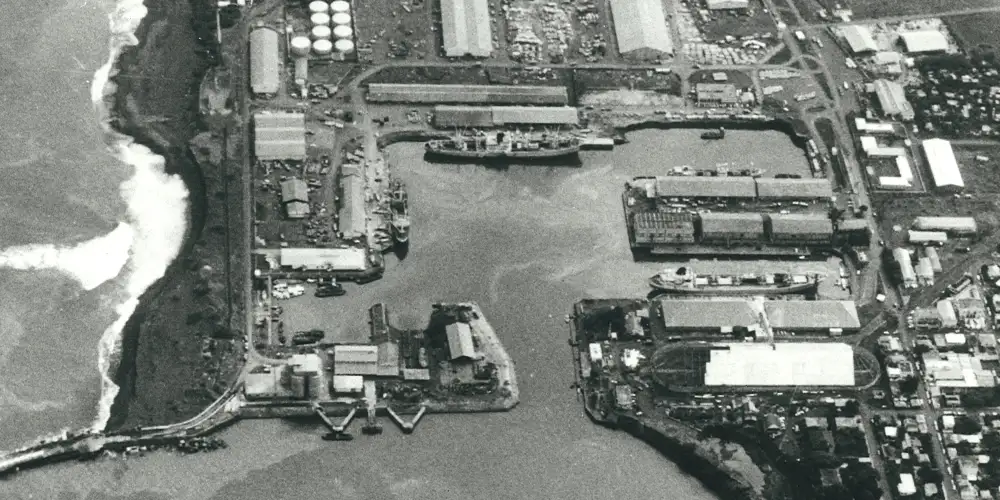
SAPMER contributes to the construction of the fishing dock at the Port of Reunion Island to build its first warehouse.


1980 – 2005
The Age of Exploration

In the middle of the 1980s, our teams set out to explore the Kerguelen and Crozet islands, a hostile zone where you have to face the gigantic waves and terrifying winds of this ice area, looking for a rare and precious species, a fish whose fishing is deserved as much as it is feared: the patagonian toothfish.
1980
The Austral
In 1980, the Pierre-Pléven, a 78-meter Newfoundland trawler, was bought from Saint-Malo and renamed Austral. She was fitted out for lobster fishing and kept her trawling equipment.


1981
First fishing season for the Austral
SAPMER’s activity was focused on fishing in Kerguelen, a group of islands even further south than Saint-Paul and Amsterdam.
From 1981 to 1986, the Austral alternated between rock lobster fishing in Saint-Paul and Amsterdam and ice-fishing in Kerguelen.

1986
Beginnings patagonian toothfish fishing
That year, the Austral focused on a species that had attracted little attention until then: the patagonian toothfish. A deep-sea fish with a beautiful size and delicious flesh.
Still little-known, a Franco-Soviet research campaign, led in 1986-1987 by Professor Guy Duhamel, ichthyologist at the National Museum of Natural History in Paris improves understanding of this deep-sea species.


1993
A new vessel for rock lobster and patagonian toothfish
In 1993, SAPMER acquired a new freezer vessel, built in Poland. The freezer trawler, equipped for rock lobster and toothfish, was given the same name as her predecessor: “Austral”, and measured 76 meters by 14 meters.
The Austral is fitted with new equipment to improve its fishing performance. Continued discoveries of patagonian toothfish in Kerguelen, and soon in the Crozet Islands, raise great expectations.


1997
Regulations and the end of trawling
At the end of 1997, Parliament passed a law severely punishing illegal fishing in the TAAF, requiring all boats entering the French zone to report it.
The TAAF administration restricts authorized catch tonnages and gradually imposes the abandonment of trawling in favor of deep longline, a more selective fishing technique.

2001 – 2002
Expending southern operations
SAPMER orders 4 freezer longliners from the Piriou shipyards in Concarneau: the Croix du Sud, the Mascareignes III, the Île Bourbon and the Albius, which will join our fleet between 2001 and 2002. For its part, the Austral has returned to its original vocation as a rock lobster boat and freezer.

Croix du Sud
Formerly an illegal longliner, it became the property of SAPMER in 1999 and was extended by the Piriou shipyards.

Île Bourbon
Built in 2001, this is the first boat of its type to be built in a French shipyard.

Mascareignes III
Built in 2001 by the Piriou shipyard in Concarneau, this is a sistership to the other longliners.

Albius
Also built in 2002 by Piriou shipyards, this is a sistership to the other longliners.
2003
Setting up a patrol boat
The Osiris, an illegal longliner, was salvaged and converted into a civilian patrol vessel managed by GIE Protection Toothfish and Halieutic resources and armed by SAPMER: five months a year.
It carries out fisheries policing and surveillance missions in the exclusive economic zone of the French Southern and Antarctic Lands, mainly in the Kerguelen Islands.


The Osiris
2005 – 2012
New Horizons
This desire for conquest, always conducted with respect for people, the environment, and species, remains undiminished as SAPMER embarks on a new adventure in the Indian Ocean.

2005
The development of tropical tuna fishing
Tuna is the main fishery resource in the tropical Indian Ocean. For SAPMER, aware of the strong demand from the Asian market and the growth potential in Europe , tuna represents a diversification opportunity which is confirmed by studies and trials.
Tuna activities are managed from Mauritius and the Seychelles.


2009
The Franche Terre
The first vessel in the series was built in Concarneau. Named Franche Terre (a locality in Sainte-Suzanne, Reunion Island) in May 2009, it began its maiden voyages in the months that followed.
At 90 meters long, it features the most advanced fish detection systems. Its most significant innovation is its propulsion system: two electric motors powered by a main diesel engine, that drives the propellers.
The vessel’s electrical power also enables fish to be deep-frozen in a reduced time, ensuring that the quality of the flesh is preserved. The vessel’s electrical power also enables deep-freezing of fish in record time, preserving the quality of the flesh.
On board, fish is processed in two stages: First, it is immersed in an icy brine bath, then transferred tanks at -40°C, where it is kept frozen until landing.
2009
SAPMER goes public
To finance its new strategy, SAPMER went public on the Euronext Growth market in July 2009, becoming the first fishing company to be publicly traded.
2010
The Bernica
A new tuna seiner joined SAPMER’s fleet in November 2010 , named Bernica, it was built on the same design as the Franche Terre, retaining its modernity, speed of execution and efficient fish processing.


2012
The Dolomieu
On March 22, 2012, another tuna seiner was inaugurated in Vietnam before heading to Réunion Island, where a commissioning ceremony was held on April 27, 2012. The Dolomieu began its maiden voyage in the following weeks.
2012 – 2023
A key player in sustainable fishing
The SAPMER teams, both at sea and on land, have always worked for responsible and sustainable fishing. During this period, the awarding of certifications has rewarded these efforts and testified to our constant commitment to improving our practices for ever more responsible fishing.
2006 – 2017
Scientific partnerships
During this period, SAPMER actively contributed to enhancing knowledge about marine species from the TAAF, through collaboration with the French National Museum of Natural History.
Data on marine biodiversity was collected on board SAPMER’s vessels to feed scientific databases.


2013
First certification – Sustainable fishing
SAPMER obtained MSC (Marine Stewardship Council) certification in 2013 guarantying the sustainability of the Patagonian toothfish fishery around the Kerguelen Islands. MSC certification is an eco-label recognizing the sustainability of fisheries.
Under strict specifications and through annual audits, MSC ensures the preservation of the resource, respect for ecosystems and the effectiveness of the fishery management system.


2017
The opening of Les Comptoirs SAPMER store
Inaugurated in 2017 on Reunion Island, Les Comptoirs SAPMER is a short-supply-chain fishmonger offering exceptional fish and seafood products. This store aims to make products caught by SAPMER’s crews accessible to all Reunion residents, whether professionals or private individuals.
The range includes premium-quality products fished in the French Southern and Antarctic Lands and the northern Indian Ocean.

2017
A second MSC certification
SAPMER obtains its second MSC – Sustainable Fishing certification, once again recognizing the sustainability of the Patagonian toothfish fishery around the Crozet Islands.

2018
Creation of a technical and logistics base in Concarneau
To be at the heart of the French tuna industry, SAPMER opened its new technical and logistics base in Concarneau, Brittany.
This new organization manages tropical tuna activities from Concarneau, with a base in the Seychelles as a central location for fishing, landings, logistics, and stopovers, as well as support operations in Mauritius.

2018
The Cap Horn
Previously owned by Cap Bourbon, the Cap Horn joined SAPMER in October 2018, replacing the Croix-du-Sud.
This acquisition provided SAPMER with a uniform fleet of four sister ships, including the Albius, Mascareignes III, and Île Bourbon.


2020
Third certification – Sustainable fishing
SAPMER obtained MSC (Marine Stewardship Council) certification, recognizing the sustainability of the southern rock lobster fishery around the St. Paul and Amsterdam islands.
- The population of the resource is in good condition and able to renew itself
- The best practices implemented by SAPMER teams ensure respect for the ecosystem and other marine species.
- Fisheries management rules ensure sustainable resource management
2023 – Today
A 100% French fleet
In 2023, SAPMER refocused its operations on a 100% French fleet, reinforcing its position as a key player in sustainable and responsible fishing with eight high-performance vessels.

Toothfish fishery
4 longliners

Lobster fishery
1 Caseyeur

Tuna fishing
3 Tuna vessels
2024
Fourth MSC certification
SAPMER obtains its fourth MSC certification, recognizing for the first time the sustainability of the skipjack tuna fishery in the tropical waters of the Indian Ocean.
This certification rewards the work of all our teams in securing tropical tuna stocks, reducing by-catches and protecting marine ecosystems in the Indian Ocean.

2024
Renewal of the Board of Directors and expansion of the shareholder base
At the beginning of 2024, SAPMER began a new chapter by expanding its shareholder base with the entry of local Reunionese investors and a capital increase to strengthen its equity base and invest in the future.
As a symbolic company of Reunion Island, this new start allows SAPMER to remain independent, consolidate its Réunionese roots with capital fully owned by local interests, and preserve the integrity of its operations in its 3 fisheries: patagonian toothfish, rock lobster and tuna.

New horizons
SAPMER strengthens its financial position with a capital injection. This funding enables:
The renewal of its longliner fleet and the Austral vessel.
Necessary investments to maintain the operational condition of its three tuna vessels.
Refocused on French operations, debt-free, with approved capital increases and an expanded Board of Directors, SAPMER opens a promising new chapter in its history and development.
SAPMER Today
8
Vessels
The company has four longliners, three tuna boats and a caseyeur.
30
Countries
Recognized for their exceptional quality, our products are available in many countries.
600
Employees
Passionate about the sea, working for sustainable fishing that respects the environment
141
Revenue
Listed since 2009